Be yourself; Everyone else is already taken.
— Oscar Wilde.
This is the first post on my new blog. I’m just getting this new blog going, so stay tuned for more. Subscribe below to get notified when I post new updates.
Living with Art
Be yourself; Everyone else is already taken.
— Oscar Wilde.
This is the first post on my new blog. I’m just getting this new blog going, so stay tuned for more. Subscribe below to get notified when I post new updates.
I am Dr. Manjiri Thakoor, researcher of Ancient Indian Culture from India, teaching Art History and Aesthetics for the last 25 years. While doing my Post Doctoral fellowship on 18th century painted manuscripts “Madhu Malati”, I came across a resourceful collection of Hindustani Manuscripts (MSS) at the John Rylands Library (JRL). My hunt began with emails exchange with absolutely prompt responses giving me positive answers and welcoming invites.
I reached the John Rylands Library only to be awe struck with, not only the collection but also with the maintenance and cooperation of the Rylands Library staff. My first many mails were addressed to the then Joint Head of Special Collections, John Hodgson, which were extremely fruitful. I learnt about the collection very well. I was connected with the new curator Zsofia Buda, who was helpful in my hunt. A young and energetic girl Nicole was tirelessly helping me with the heavy folders of MSS. JRL folios resting gracefully of a soft pillow to allow its shape and fragile posture to remain intact was given to me by a young girl Nicole. She also assisted me with a few sheets of paper and pencil to make my notes. The quiet and quaint library then allowed me to disconnect from the entire world around and I opened it to see the beautiful folios.
Adi in Sanskrit means First. There are many versions of this magnum opus epic in the Indian subcontinent since many hundred years. The verses were originally recited and later written. While the Sage Vyasa is known as the original composer of Mahabharata, in the following centuries, the popularity of these stories resulted in hundreds of written and illustrated versions of the Epic. This blog is specially curated to throw light on making of this Adi Parva and I am going to discuss on the MAKING of the MSS and the characteristic features with reference to two different sets, one set of loose folios, the other put together in binding.
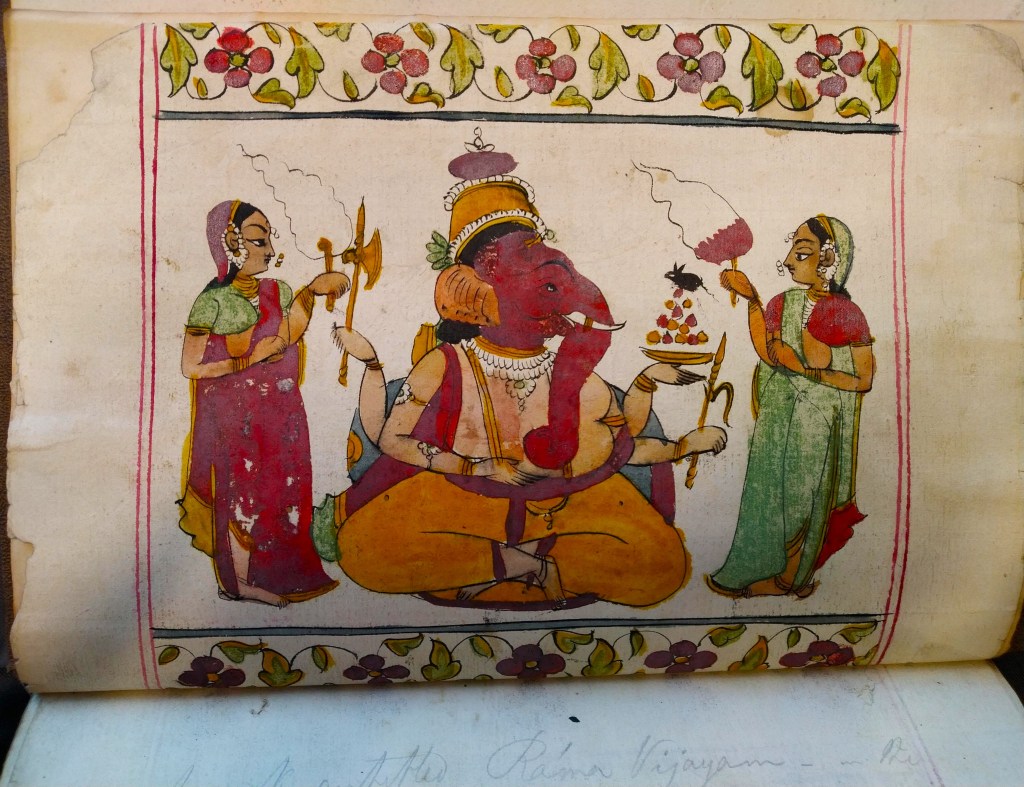
In India every NEW beginning is associated with the worship of Lord Ganesha (the elephant head god). It is said that the epic of Mahabharata was written down by Ganesha on the composition of sage Vyasa.
Here is the painting of the four-armed Ganesha holding His weapons in two rear hands and a plate of sweets with a mouse on top of it (much animated, as if in conversation with the God) in one hand, while the fourth-hand rests on His big stomach, flanked by two consorts Riddhi and Siddhi holding flying whisks. Showing the face in complete profile is very common in miniature painting, a much easy application of face for artists for mass production of MSS.
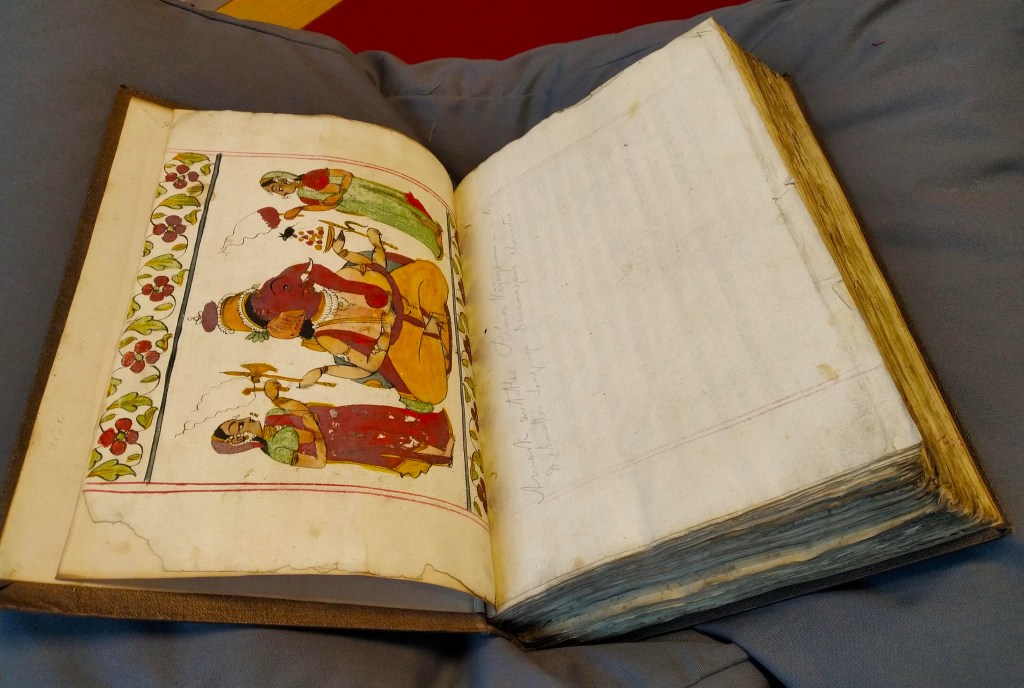
Composed in a dramatic floral design are the images of Lord Ganesh with his consorts Riddhi and Siddhi (meaning Wisdom and Power to attainment respectively). The figures show the Deccan Maratha influence on their clothing (a long nine-yard sari) and jewellery (a peculiar pearl nose pin resting on upper lip). Both shown with whisk in their hands blowing gentle wind to Ganesha. With limited colours used here, we see artist making no compromise with quality of the work and continue to render as many details as possible with a very thin brush, seldom with single hairbrush.
The reason to this limitation of colours is in its organic structure. The colours were made at home with natural pigments. Yellow or Indian yellow as we see here, obtained from minerals or plants, green often mixer of yellow and blue and red from the soil or with treatment on turmeric. Such three colours were most popularly used and were also considered to be holy when the turmeric was used.
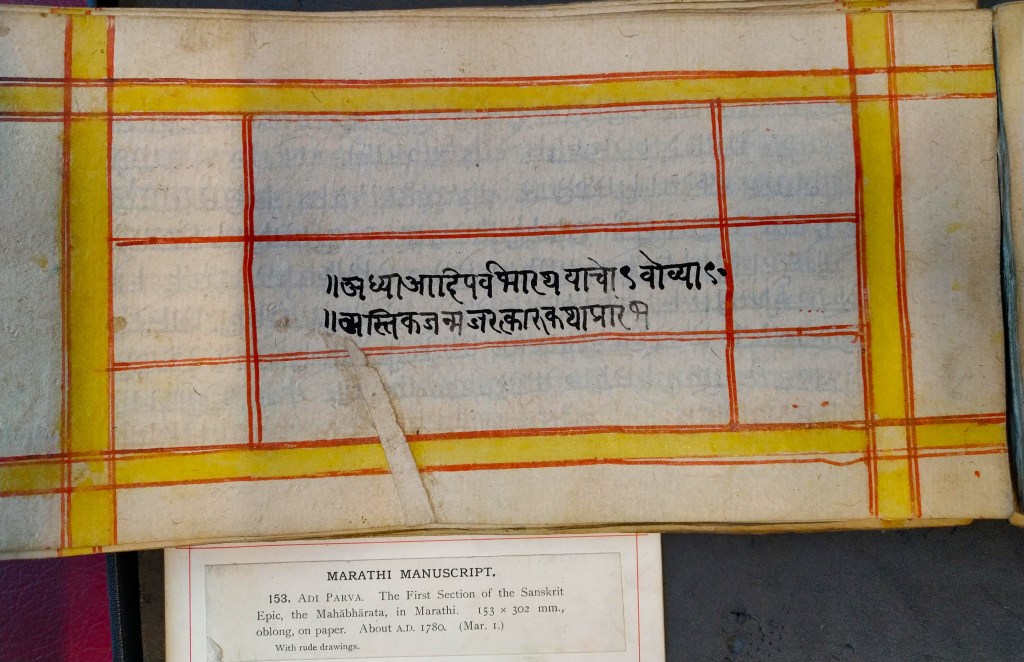
These MSS are in the form of loose folios. Each page is written on obverse and reverse side with black ink, on both the sides are the bright yellow thick borders and thin red lines, both the colours are organically prepared.
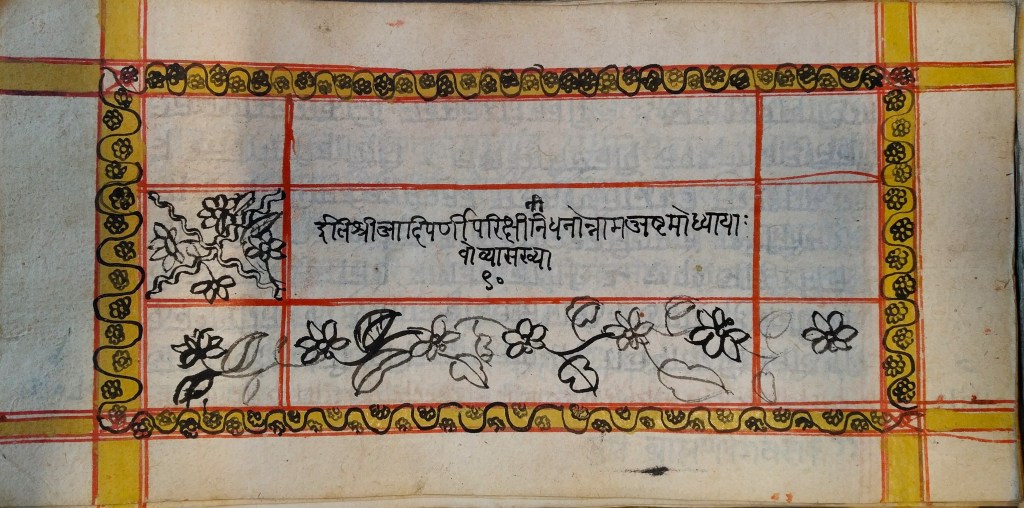
The other set of loose folios in the collection of JRL is dated to c. 1780 (fig.3, 4). Entirely handwritten with a bit of crude or rough writing and with a very few illustrations, it triggers a few curious points and comes up with answers of few out of them. To begin, this one set is written in Marathi, and is from Maharashtra. Though the original Adi Parva is in Sanskrit as said earlier, this one is from those many versions written over a huge timeline. Marathi being my mother tongue, there was feeling of close connectivity with the text, the dialect of the 18th century (of which obviously many are gone under the sands of time).
The style of writing and art belongs to the 18th century Maratha Dynasty period. This was particularly the time when the recital of the verses from Ramayana and Mahabharata was very popular. The verses then were written in many Brahmin families as part of custom. Not every family belonged to the artist community, hence the text often dominated the MSS. However, in few cases we see the writer taking initiative to render some line drawings, which could seldom look like a professional artwork and often resulted in crude sketches, only to be able to interpret by the family and not public. The line drawings showing four-armed deity (Vishnu?), face in profile.
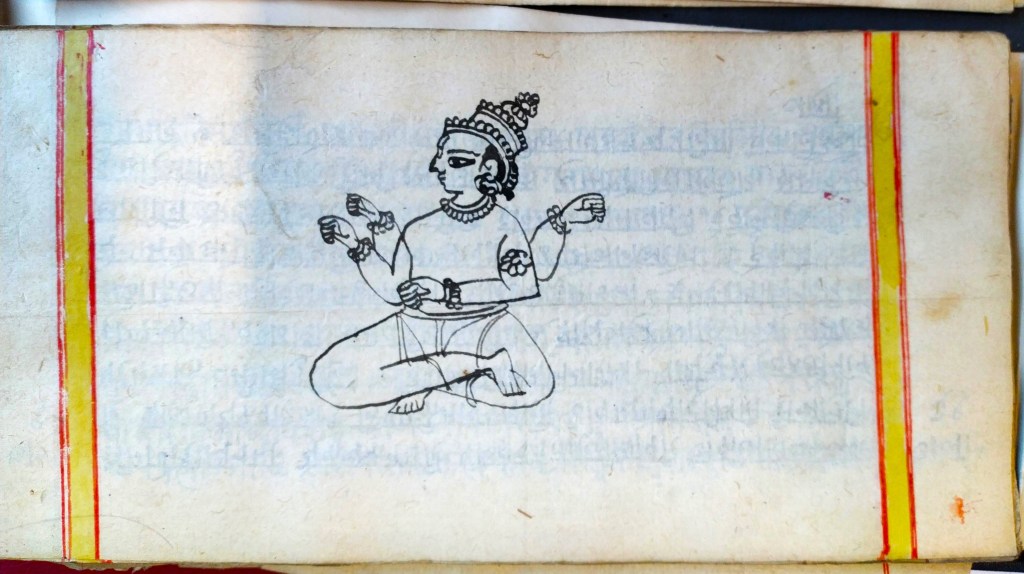
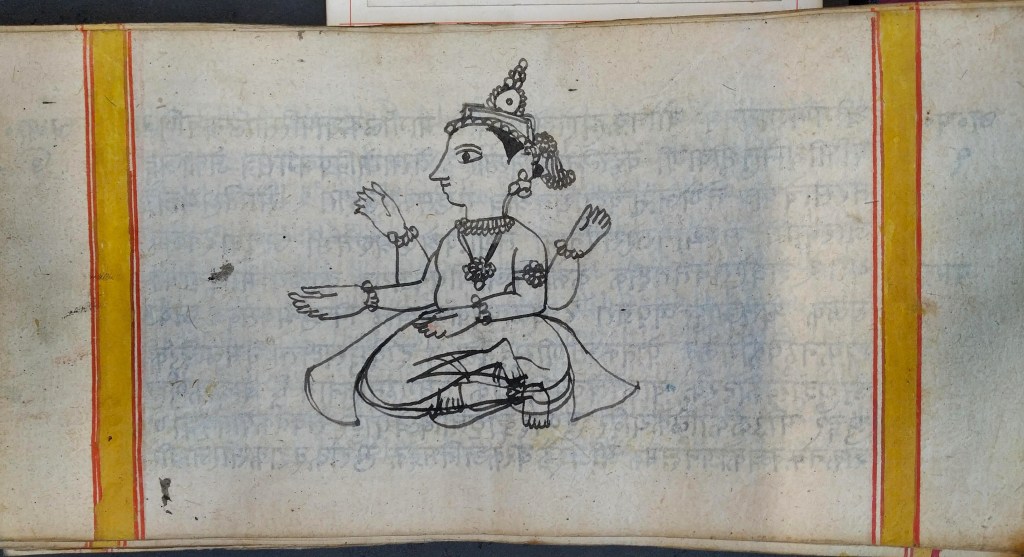
The above figures (5,6) have no sophisticated rendering at all. They are probably meant to be there as a part of symbolic appearance, to indiacate the auspicious text. Looking more like a sketch, they belong to the Deccan art style, which emphasises on thick lines and pump bodies if not robust.
The significance of the borders need to be understood in the ancient Indian text. The two specific colours yellow and red are much symbolic in Indian rituals. Totally organic, these colours are considered as holy colours, those of turmeric and kumkum, the composition of specific soil (tapioca) and turmeric, considered as very auspicious powder and hence used in every ritual by both men and women. The outlines create a frame or a margine for the writer to begin. The MSS misses the horizontal lines, leaving the reader surprised, for most often the words do not get jumbled. The handwriting of this MSS particularly, even though several pages, looks much neat and tidy and almost all the papers are outlined.
The drawings on many folios are extremely crude yet interesting as they belong to the typical folk nature of art practices, mostly subtle geometric patterns and floral forms, not following symmetry or repetition.
The entire collection of Hindustani MSS at the JRL is prodigious collection depiction knowledge and aesthetics of the ancient culture. I sincerely thank the entire team of JRL for having given this precious experience to me. The library has indeed made all the possible efforts to protect and store these MSS in wonderful infrastructure under the supervision of experts. I thank Dr Zsofia Buda for her valuable time for discussions and of course the young girl Nicole for carefully giving me all the needed assistance.
Two artists, Two centuries, Two pioneers, Two Art Movements
Mesmerizing trajectory of art…zooming between the colours……loving art…..
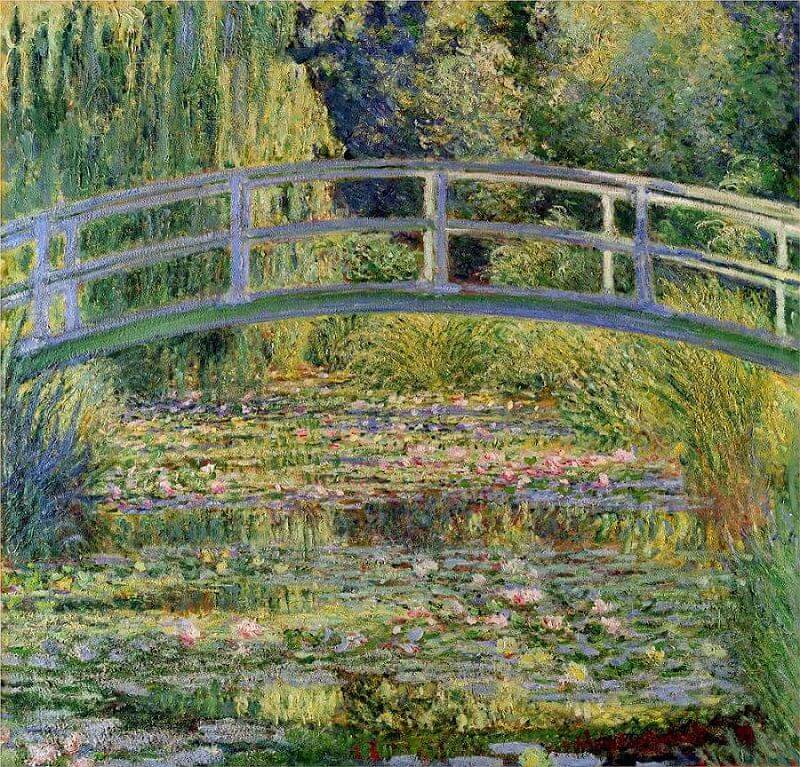
France, the year was 1872, Oscar-Claude-Monet began a new wave in art. He began painting things he saw with a touch, a touch of his own. He painted things the way he felt them. He went out..again and again. He brought with him something which remained with him not the way it LOOKED, but the way he saw. He picked up bright Sunlight, packed it in his bags, spilled the same in his studio and went on slicing the light he had CAUGHT!! Now he knew where to PASTE these small pieces of Sunlight. He opened his colours and began..the endless patches of what he saw in the nature. Well, it was three dimensional. He knew, the work is exhaustive. He had to bring in his passion for what he saw out of his studio. The nature was 360..all over. He refused the flat two dimensionality. The process was on and on until finally he did the IMPRESSION of what he knew was right according to his mind. A stronger version of his own visuals….an IMPRESSION!!
Now interestingly in the same year in Netherlands was born Piet Mondrian. Here the drama which was to follow crossing the two centuries was in the making already. Just imagine, did they ever realized what was coming between them to establish something so unique and so magnificent? Did they even visualize something unusual would come out from the extraordinary Pandora box, which actually never ever existed?
The play begins. Colours, many colours like never before, Monet opened up a new scale to measure the colours. He made them three dimensional. He worked out on the actual texture that he perceived from the nature. He made the colours look like blocks…irregular blocks. Like they are in their real form in the nature. Not in order. Absolutely free to spread in any direction. And then was created optical extravaganza. The canvas became loaded with nature seen by Monet. Mission Impressionism began with many more stewards joining in and one was Deags painting lovely Ballerinas with lovely fringes of their dresses which Degas hardly painted…he just sprinkled, textured, scattered the edges of the transparent dresses of the dancers. The drama of colours or the trick of application?
It then ran between the years 1874-85, through more than ten exhibitions and then came Post Impressionism…..in 1900 where Cezzanne, Seurat and Vincent Van Gogh began playing with diversity.
Around this time, it is very difficult to hold back on Van Gogh..who is loved by many. The Dutch painter is been talked by many in the past and shall continue to be part of the talks in future as well. Mondrian was only twelve when Seurat did his pointillism…dots and dots and eight years later Van Gogh left the world, leaving many questions unanswered.
His enigma went with him, what was left behind was the mystery of Starry Night and number of Sun Flowers. Henry Matisse became fierce and Edward Munch SCREAMed to EXPRESS and Picasso travelled from his blue period to geometry, The canvases began looking vibrant and different. Illusion, sentiments, expressions, speed, dance, poetry, violence, rhythm, music…all was in and around, everywhere. Wassily Kandinsky “Painted” colours. From Russia to Scandinavia, from Europe to America, the actions and reactions were spontaneous and vibrant. Those patches of colours really were making history. These colours were talking the language of all. The colours took dimensions, the colours picked vocabulary. They were simple, they were complicated. They ran from all the possible realms of human mind.
Growing up with these colours, from Netherlands HE came to France for the love of art like his fellow countryman. Mondrian began what no one could think. His passion for trees and their reflections on the ripples of the water body was irresistible. And then what happened? He began moving on with where Monet had. He found those colours with dimensions. He now made them walk and talk in discipline. He travelled to USA, and established his own signature with colours……just like Monet did when Mondrian was born, but in a little different manner.
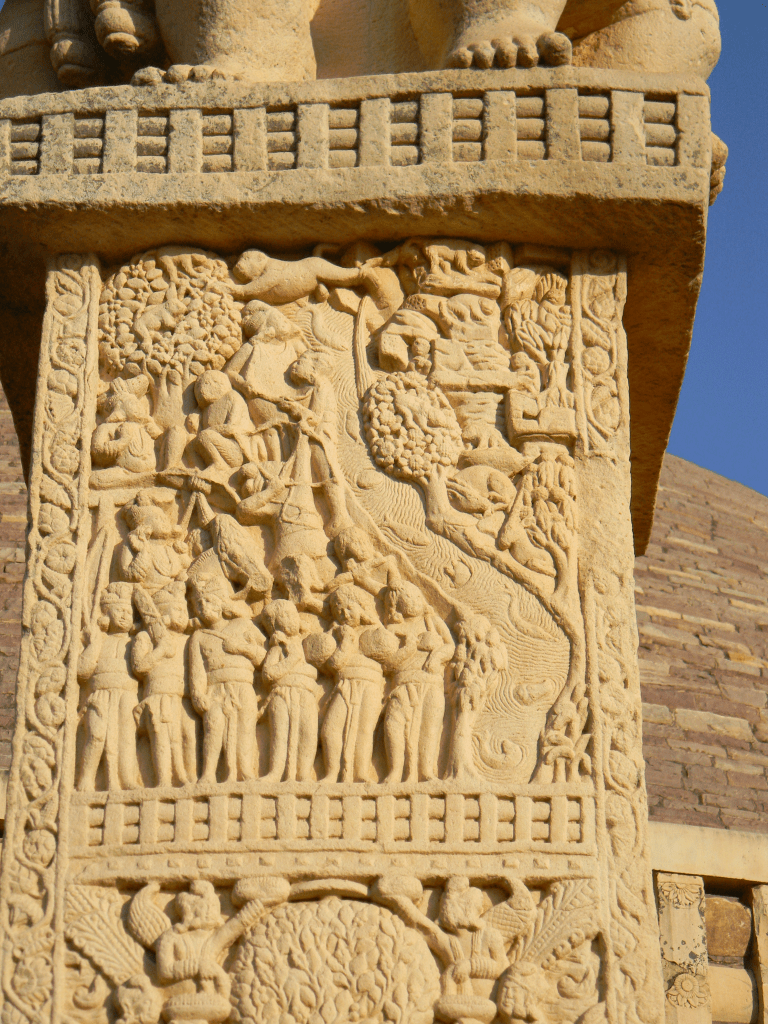
Shoooooo…….let us quietly open the secret world of stories.…
What about stories? We hear them, we remember them, we ‘act’ them, we follow them and we forward them….endlessly. Ever realized, we open our eyes in this world with stories? Right?
Its absolutely true. We heard about Gods and Goddesses, mighty, strong. They offered protection to us, they gave us strength, they saved us from perils. Then we heard about the beautiful animal kingdom, where the animals talked to each other in some imaginary world. They behaved good or bad with each other. From timid rabbit to sly fox, from wise owl to witty crow, from mighty lion to wise elephant….wow that’s the whole animal kingdom, well almost! But that’s not all, we have also heard of poor farmer, practical merchant, unhappy king, romantic prince, dreamy princess, wicked witch, honest servant…the train is too long, isn’t it? There are also many broken stories. They travel half ways, and they mix with more different stories.
These stories are endless. There are stories which a mother tells her children of vigor, valor and morals. Stories that travel with merchants and peasants, stories from mythology, stories of religion….oh I can go on. But let me talk about them is some way or the other.
So in a far away land, a king could not sleep and his wise queen offered him services with stories, till he was fast asleep. Then there was a king, who had three fool sons and to make them wise his ministers brings in a story teller who explains biggest truth of life from stories. Then there is an artist or a artists guild, now they help the king in many ways. How? Well one sings the story with music and starts dancing and acting, someone starts sculpting, then may be painting and so on…But there is an endless effort or series for the stories to be passed on over generations, hence to SAVE the stories. For what? For many eyes and ears…for yours and mine.
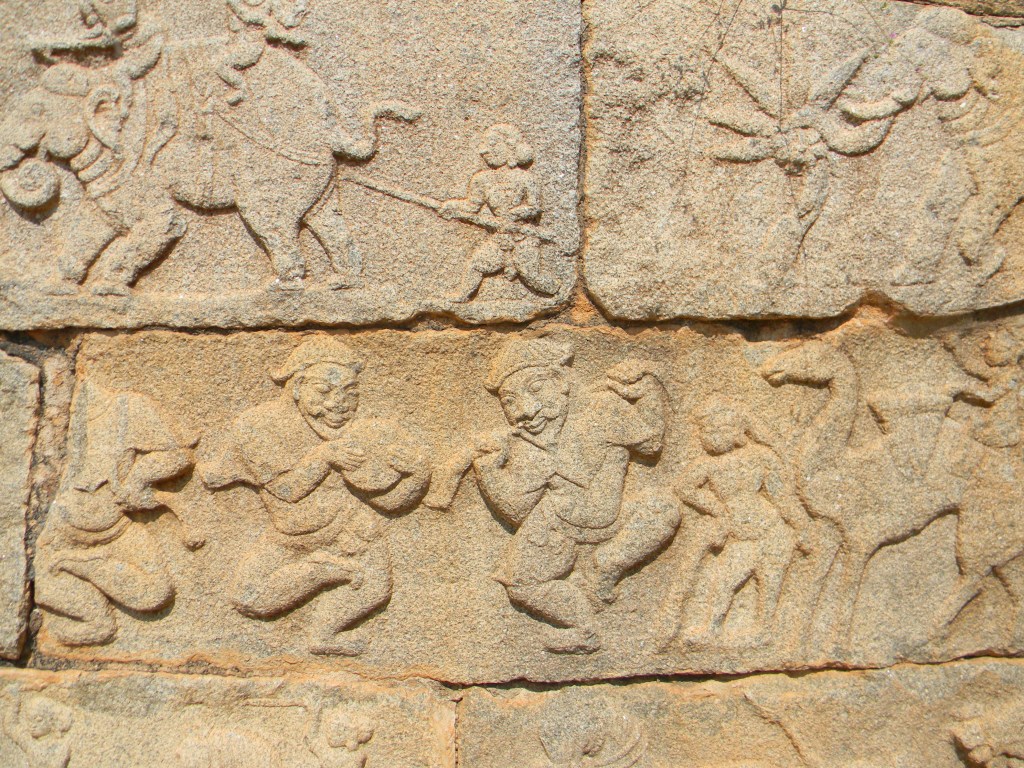
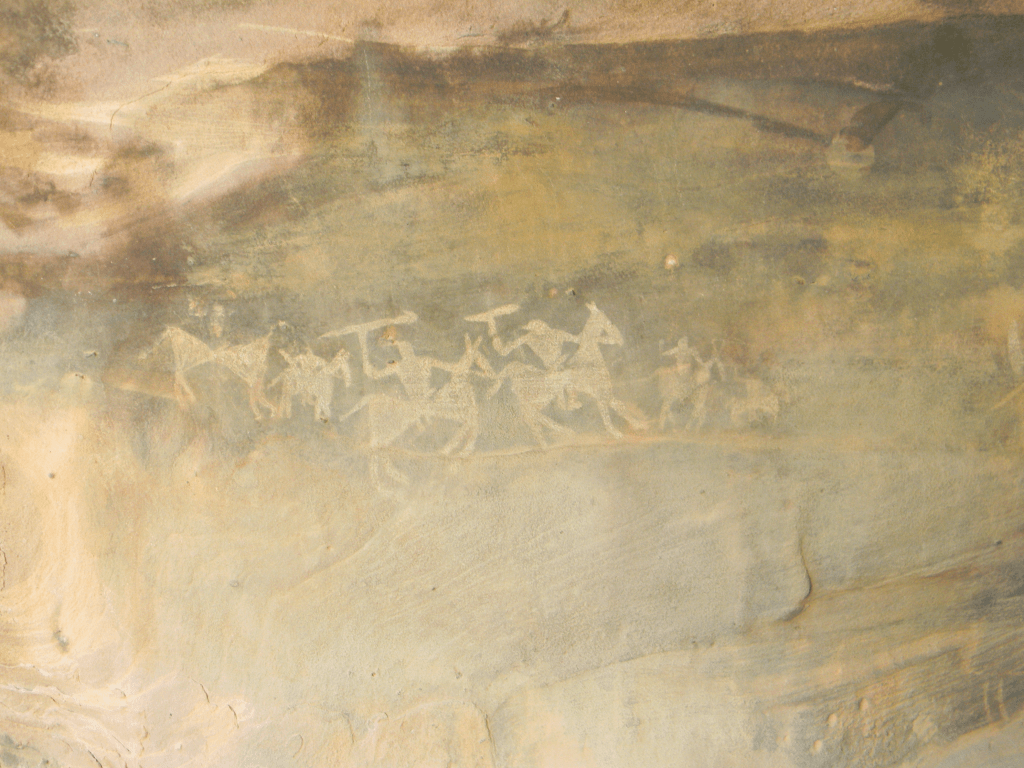
Genesis of narrations to ‘write and draw’ something somewhere is certainly and old old “thing”. Remember seeing the wild beast drawn by the pre history men? Oh yeah, and also them rendered in the frame too, like a match stick figure. Hunting, walking, dancing, drinking. What did they had to tell us? The stories by them, if at all those were stories, they were on ‘still blocks’, they did not move. They could not physically travel from one place to the other, neither there was a language that took the same faraway.
When we saw ‘civilizations’ then we saw some systematic ways of ‘writing’ stories or records. From ‘Code of Conduct’ by the kings to the basic cuneiform tablets or the painted potteries or seals. Great, so now there were ‘legs’ to the stories of some sort, and there were more eyes across their land of origin. The trades and travels made this super fast. The gradual growth of stories was to see a phenomenal revolution to connect the world. The stories were drawn on cloth, on papyrus, parchments, palm leaves, wooden boards and then saw the most user friendly base ‘the paper’. But in many countries including India they were recited for many generations before they were written down.

Now finally here’s THE story of THE story teller that surpassed many records, without even imagining the results so vast. There was a poet and story teller Vishnusharma in ancient India, sometime after the period of Lord Buddha and before the common era. Now this wise man, having perfect command on Sanskrit and good knowledge of mankind he was given a task to ‘teach’ the sons of a king. The wise composer then came up with metaphoric stories from the animal kingdom and ‘taught’ the king’s sons. He gave them five important ‘techniques’ or ‘values’ of life- THE PANCHA TANTRA’. They were so fluid, that they were soon set for a long journey. Panchatantra began travelling. Shortly the whole country fell in love with these beautiful intriguing stories, of animals, for humans. Each bard sang, each actor acted, each teacher recited, each mother entertained her children and there were more and more stories.

Now the wise physician named Borzuya, of the Persian King Khosrow, took these fascinating stories to Persia for his king in the 6th century C.E. No longer it took for the king to totally love these stories and then came in the command, “translate and illustrate them”. So the Persian land saw Panchatantra in Pahlavi “Kaarirak ul Damanak.”
What do you think happened next? Yes, the fire of popularity of stories spread far and wide. The Arabic world too loved it and adapted it, translated as “Kaalia wa Dimna.” Well well, this is not all. The moment the translation in Arabic came in, which was the largest known language of communication in the Middle East, Kaalia wa Dimna reached in every palace and every house. The 11th century saw the translation of this in Greek “Stephanites kai Ichnilates”, and through the gateway, the city then Constantinople, it entered Europe. Became popular among orthodox Christians and Jews and was translated in many many languages including Hebrew and Latin. In 16th century Sir Thomas North translated in English “The Moral Philososphy of Doni'” where he gave the credit to Doni, the Italian translator. Then with one of the authors from India named Piplay, who worked on the original Pancha Tantra of Vishnusharma, it became “Fables of Bidpai” in English which were then printed, translated in Germany in 15th century.
Travels and phonetics are ever changing and evolving. The original author and original name….all were changed and adapted by each world in their own ways. Very smoothly and soon to become part of their own culture and custom. So much so that the this became the best seller, more than 200 versions, in more than 50 countries, from Ethiopia to Russia, from Morocco to Laos…. each culture molded the stories in their own ways. Did Vishnusharma ever fathomed this?
There is more to come as the world has not much changed, at least in the habit of telling and listening to seeing the stories. It is still the best known act of mankind. Well as long as we are here to tell the “good” stories, and leave the “better legacy” for the forthcoming generations, it is certainly not a bad idea. We evolve, yes indeed, but there is no harm in keeping our roots deep in the soil who is the true Mother of all.
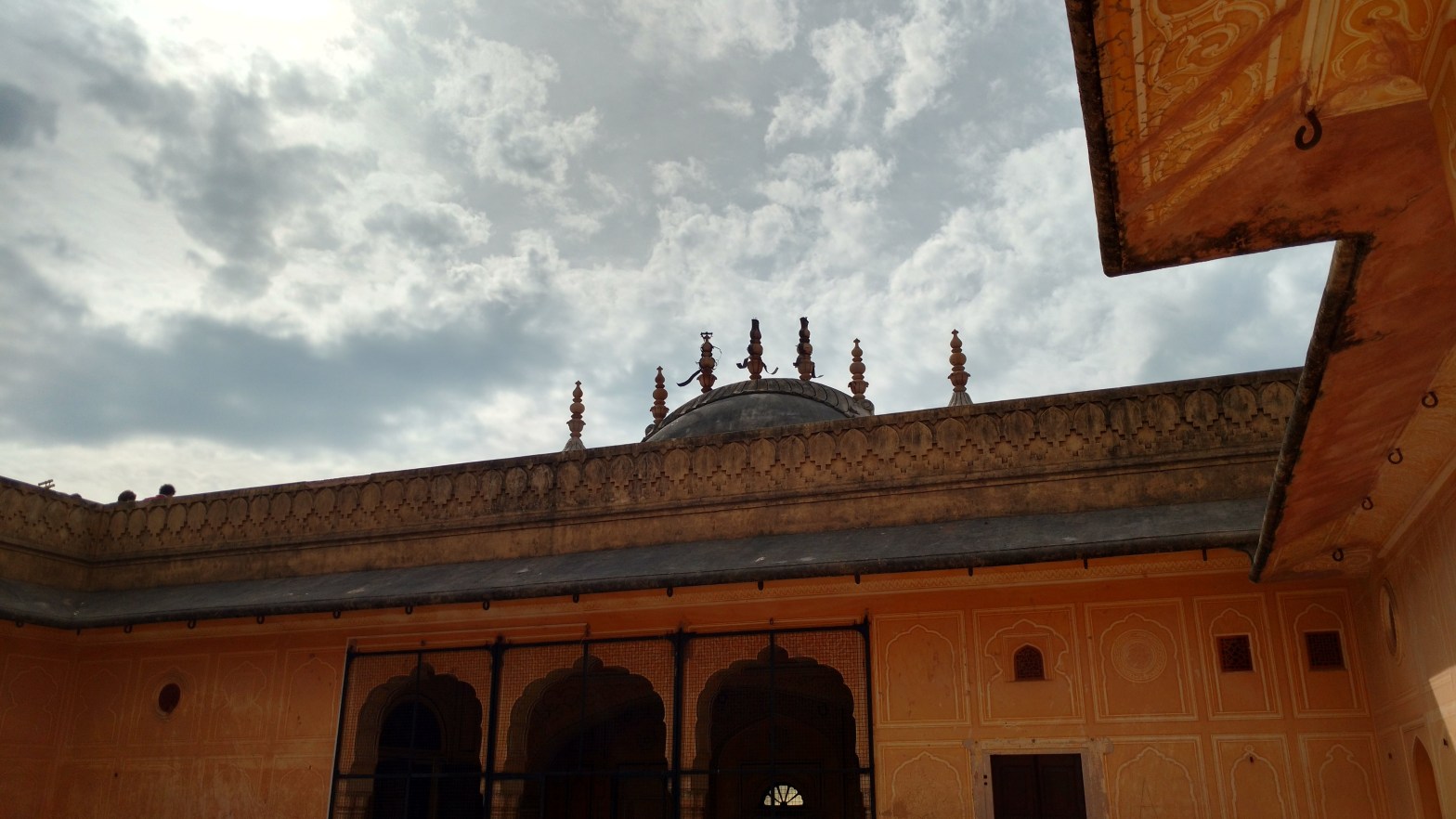
There is a way one can view the structures around. Now that we were just at the gate of the palace last time, with a young boy and his colorful dolls, I swiftly recollected my experience of bright feeling after encountering the silhouette above and around. Totally mesmerizing…then thought of various palaces which gave me the same feeling. Now obviously not all could be gathered in one go, but this one is worth a compilation of a few rough- tough and elegant ones.
Indian skies are the best backdrop for these stone and wood colossal landmarks to draw a decorative contour. Bright blue, shining as they are, fair enough to bring out the details of the curves and cones, domes and points. Various states have different silhouettes..and they all carry one characteristic feature, ‘strength’. It isn’t the size that defines the strength, it’s the material…and the design. Blocks and arches in browns and dark browns. Just imagine something looking so catchy with that color scheme. Oh yeah…thanks to the skies, what’s say ? The silhouette does not compete with the sky, on contrary I have a feeling they simply extend themselves stretching their arms to embrace the same. The love begins here, and hence a huge room for aesthetics too. While the romance engulfs you enough, you almost forget to comprehend the whole scene in words. It is better to just not get into it at all, for the very reason that is going to surprise you even more is just waiting ahead…
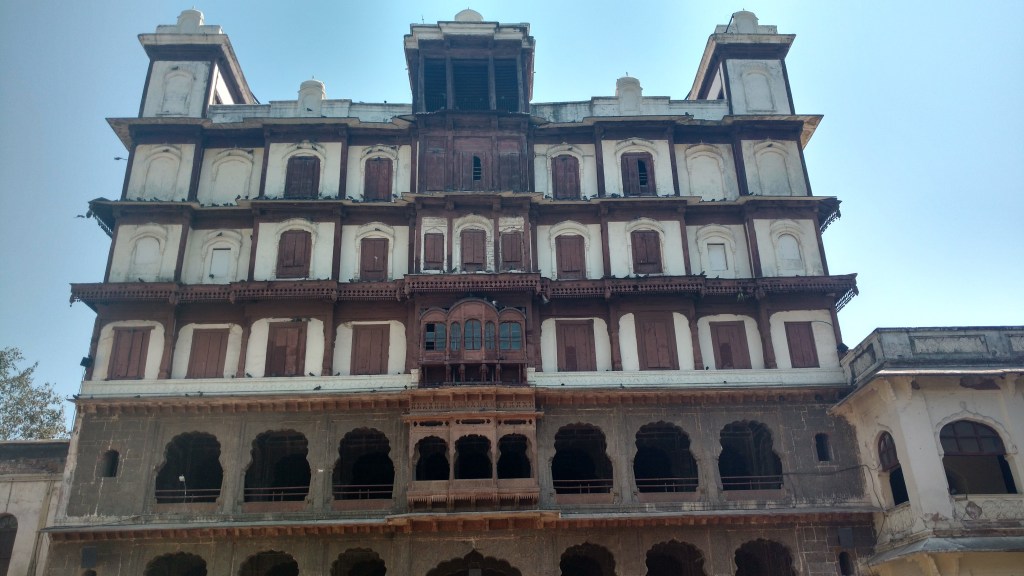
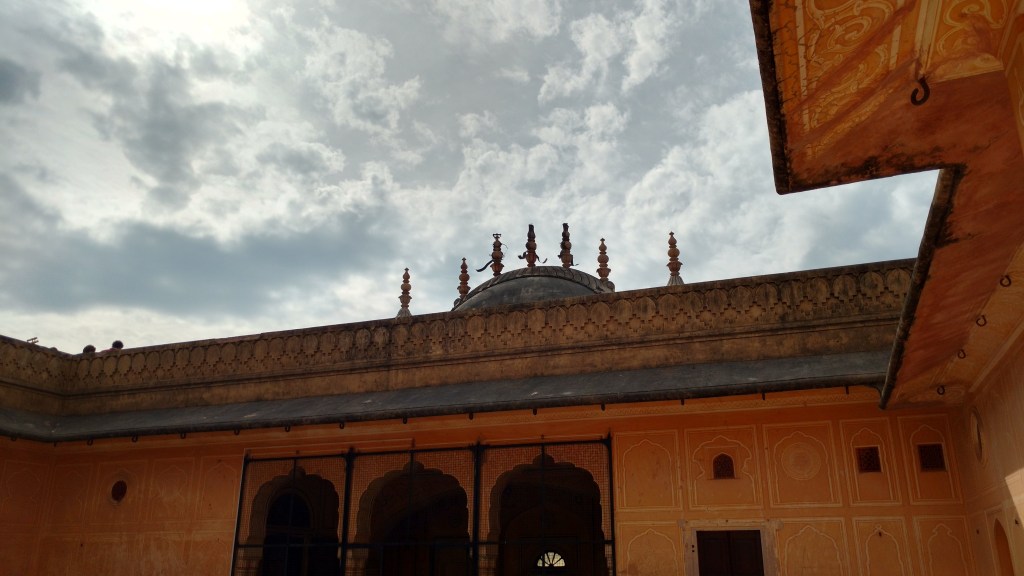
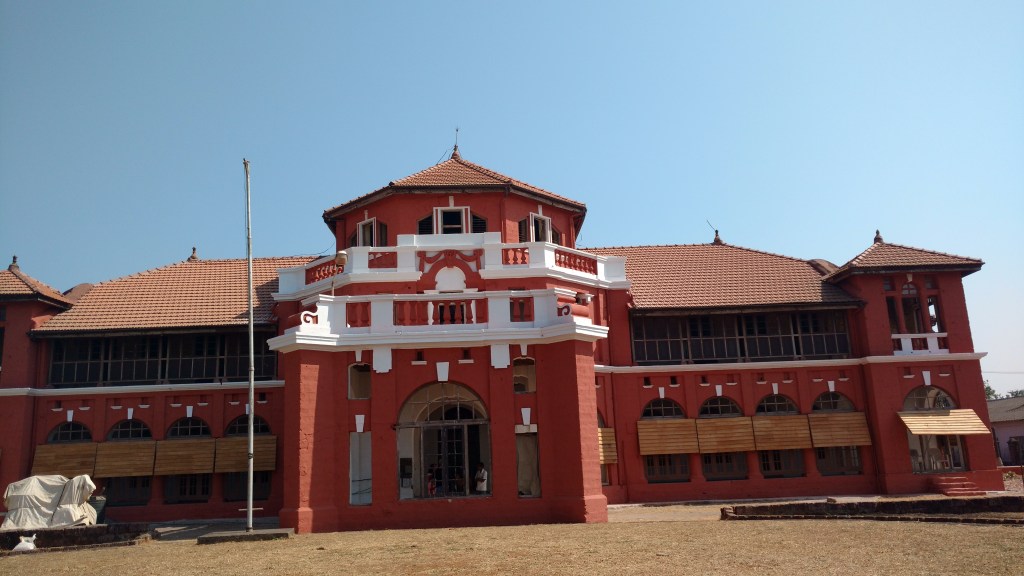
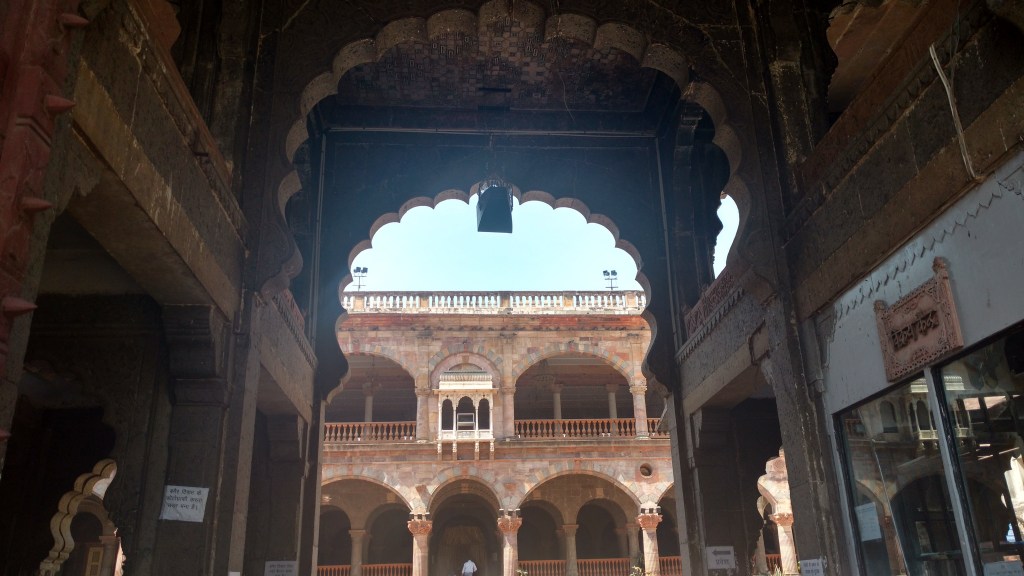
The corridors and the courtyards…..The columns and the balconies..
Now you are lost again, right? These long tunnels take you away from the sky line..the windows at intervals add a filtered light that pulls you deep inside. And in no time you forget the bright blue sky. These corridors envelop you warmly and the dramatic light that fall on slippery floors through arched wooden windows show you the mosaic dance. No sooner you forget to count how many windows did that magic with you, you land up to shake hands with the sky again….Yes you end up going to meet the skies again in huge courtyards. Here they stand between number of tall, dark and handsome escorts, overlooking them 24×7. Not just looking at them but also playing the game of light and shadows too. The columns…decorative and elegant, strong and proportionate. They hold the mighty arches and corridors, and above all, the giant palace. How they stand, as if marching around the courtyards…left right left..their shadows fall straight. Then above their heads are few more sets of corridors and breaking them in between are the faces of balconies rested on carved cornices.
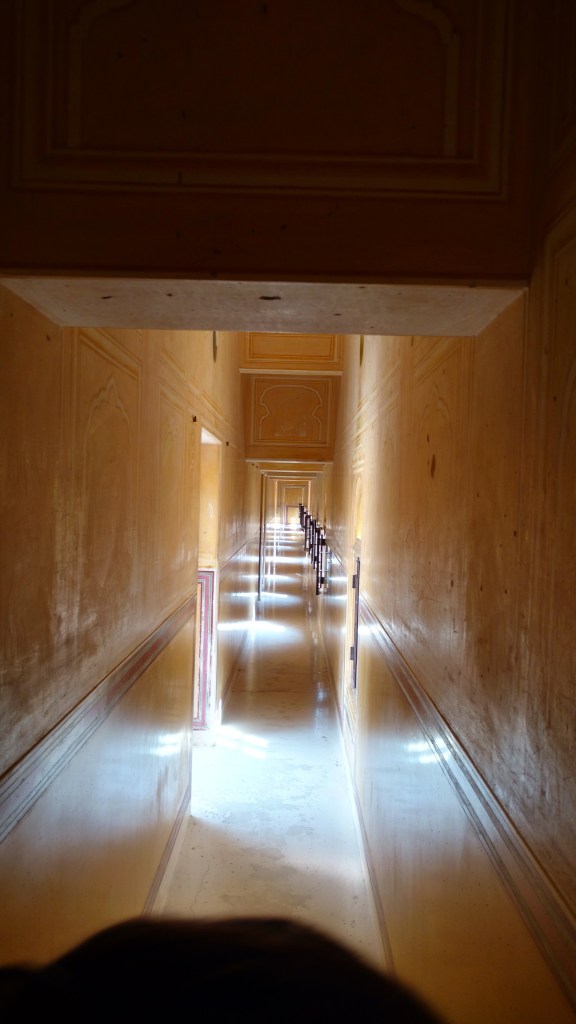
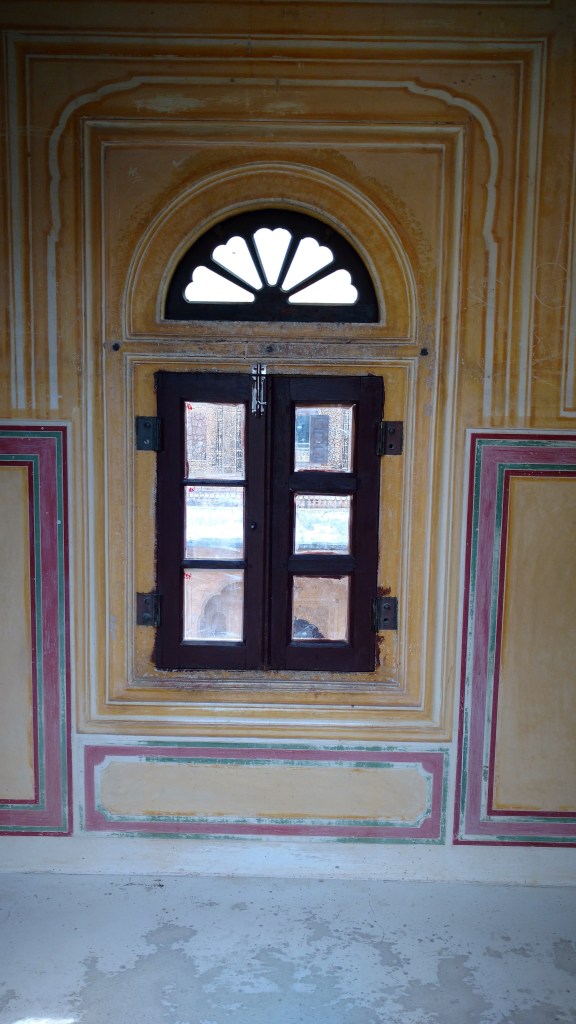
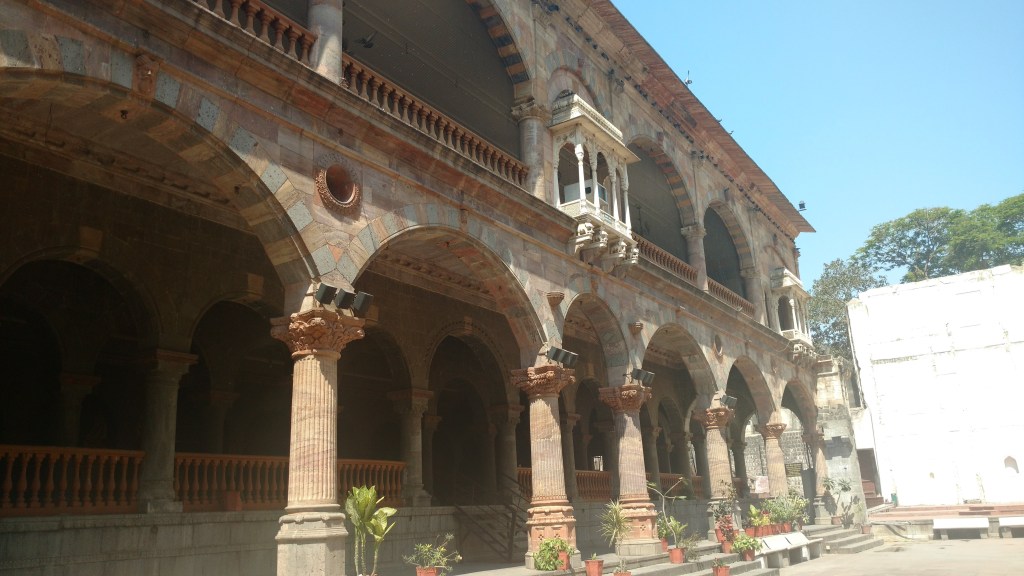
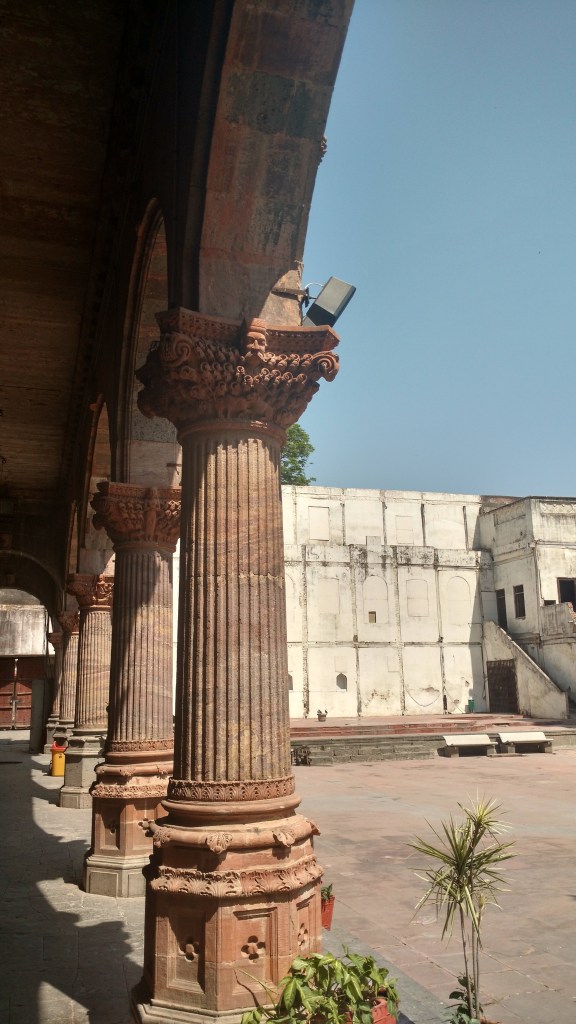
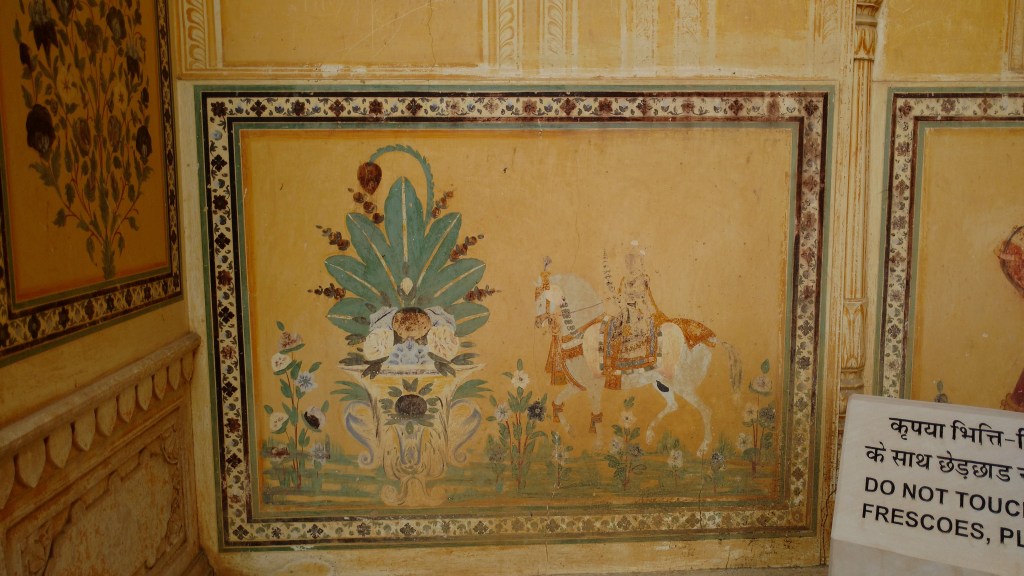
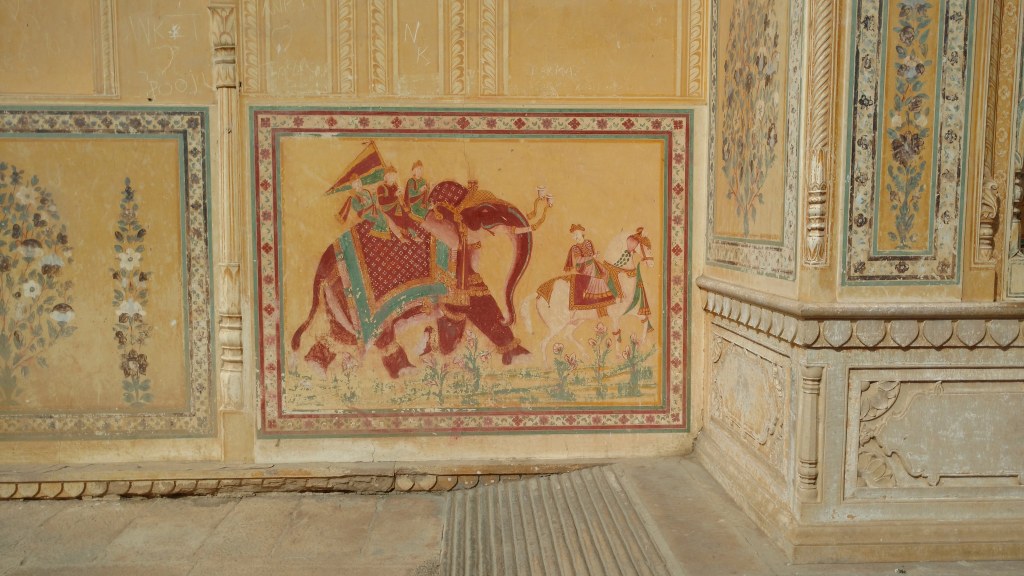
When you talk about India, how can you not say a word about paintings? These courtyards and column drama is enhanced with these beautiful paintings. Flora and fauna at their best suited roles are here. Animated and classy from the heart of rural India. The pigments are mostly natural, that is how these murals withstand all odds and savages of nature. Unfortunately they are not trained to withstand the human destruction and hence most of the times fall pray to vandalized attacks.
By end of this series on Loving and Seeing Art, which will grow more intense with each blog, you will start seeing the art around you as beautiful people. Then love the same..whether nature or man-made and never ever offense their existence.
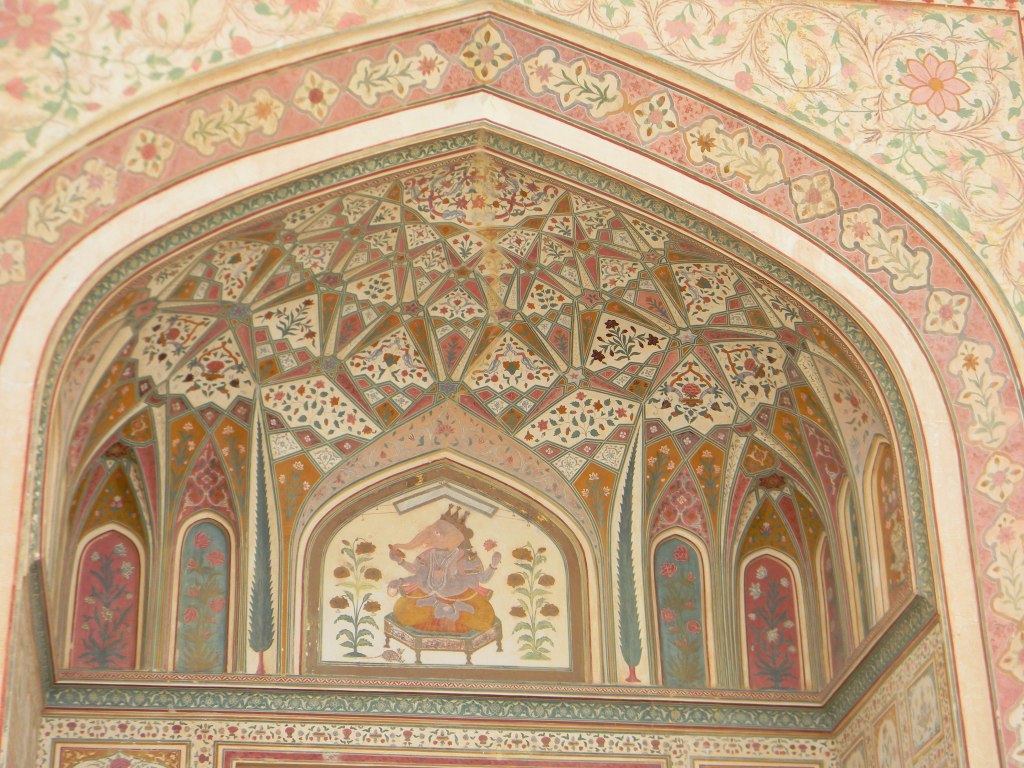
Ever wondered what is to look around like an artist? It’s simple..just be YOU. Not just when you are traveling in unknown places or mountains or heritage sites, you can practically start being YOU to look around like an artist.
India is vibrant..oh yes. the culture is colorful. You might see almost all the colors in one place at any given time. That has come from it’s rich tribal art. I always feel that when you run out of colors, you must, must google any Indian indigenous art website, and its all there. Now given chance to the contemporary world to look at a particular place which still thrives the culture of kings and queens…then you are sure to never fall short of colors at all. Rajasthan is one such place.
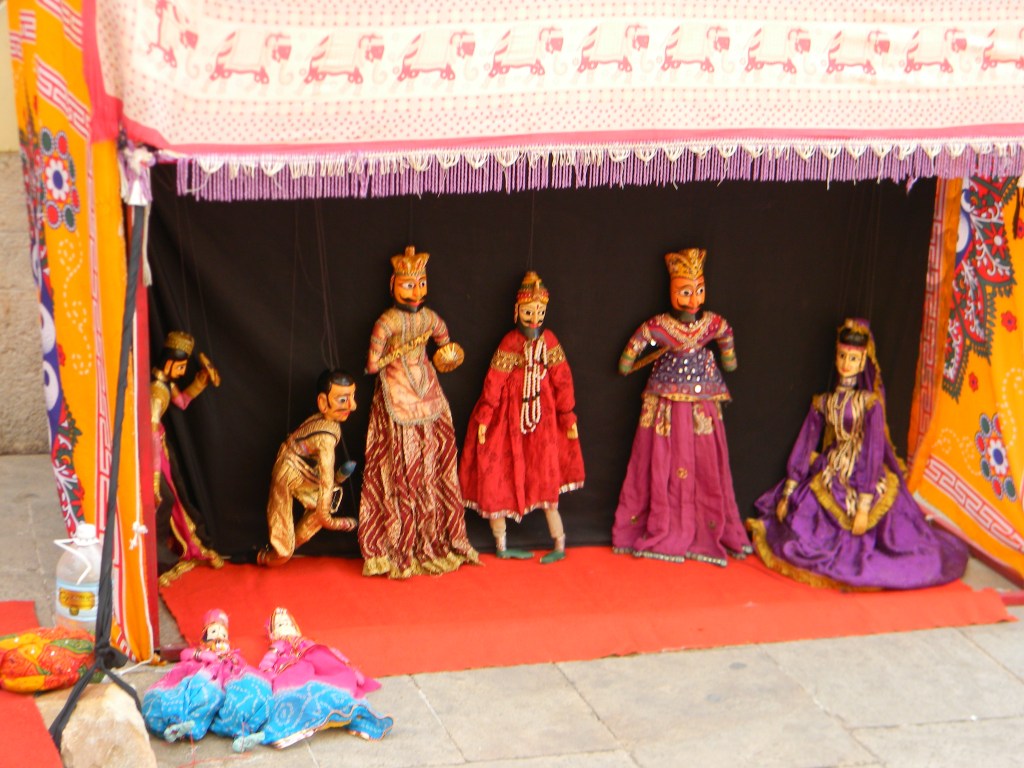
So I see a young boy with a small traveling theater standing at the gate of a old palace. He was so confident about his cute and colorful dolls. He had an old man sitting next to his small theater with a popular musical instrument…wow..and the strings of the dolls were in his tiny fingers. What a confidence. He said first see my show then pay. Loved it. The song was full of melody, the music by the old man synced pretty well and so did the doll dance. Most of the times these artists use popular stories from India, mostly from the epics. And the story talks about the valor of the king and the beauty and sacrifice of the queen. Seldom ate the romances between them. But the whole experience leaves you amazed. Well, no need of an expensive show really..
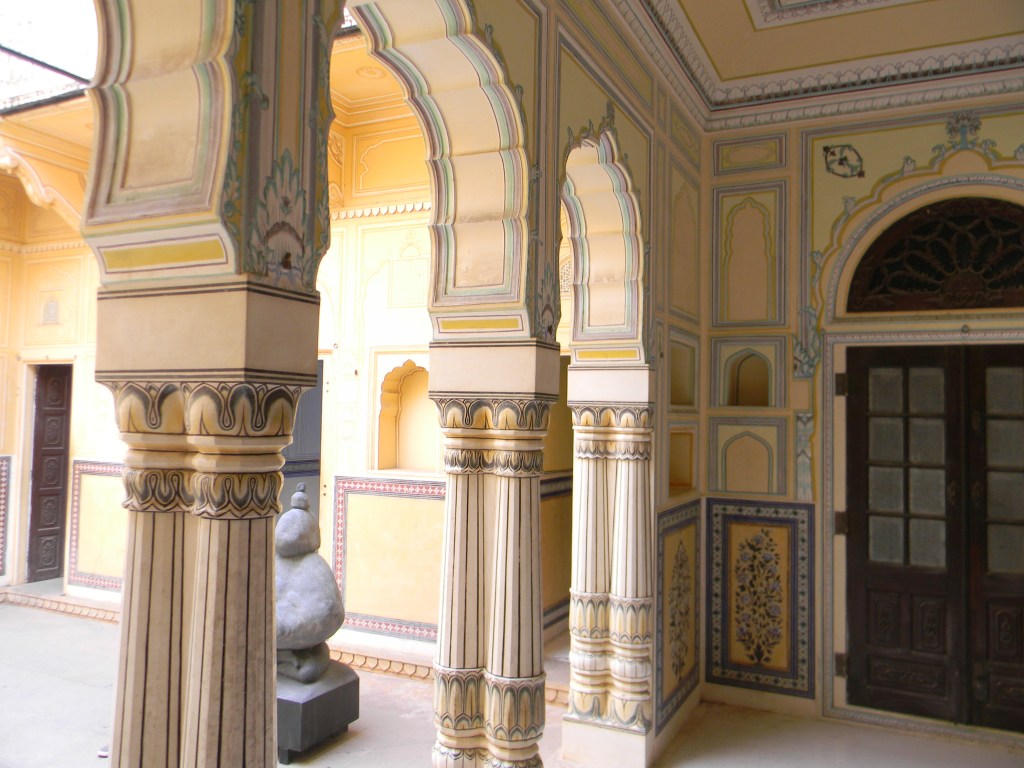
Moving ahead are the wonderful arches holding the parasol to the royals. The elegant columns and arches blending in the same, connecting a long chain…standing in various rows, undisturbed and very disciplined. They play with their own shadows and create a magnificent ballet. The decorative columns running with design patterns all over start hide and seek with the bright Sun. In Rajasthan the brightness of Sun is charming. The palace looks as if bathed in golden powder. Colors abundance…here it is. The shadows are exclusively dark. The chiaroscuro is astonishing. Like a huge canvas.
Why don’t we now look a little more above, above those dancing arches? Yes, wonderful, now you see a huge dome like arch with intricate design patterns. Thousands of flowers and leaves, spread of various labyrinths in and around maze of multiple arches. They overlook on you, like a designed sky. They are clear, wide and curvaceous, symmetrical, subtle in colors and graceful in posture.
When you look at them as humans they talk to you. They change their forms with each passing Sunlight and breeze. So how difficult was it to see art around us? Well this can be treated in some mundane stuff around as well. Oh yes, why not? Let us try next time. Keep reading.
“Hi! after long time?”
“Oh yeah, nearly fifty years now..”
“Right. Surprising, I was always around. You never saw.”
“Hmm..had too many things around.Just missed your presence. Sad, but true…”
“Never mind. I am always there for you. I watched you growing, laughing, crying, winning, loosing….but sad…you never saw me nor even acknowledged my presence.”
“True that! I don’t deny. I can’t deny. For I know I did ignore you. May be a few times I think I saw you from very far, almost in haze. I guess you desperately wanted me to look at you. You tried all you could…but I was in a rush, for something more important strike me then.”
“Oh yeah, sure! Everything else was very important for you, always. But I am glad that we meet now, finally.”
“Did I disappoint you all these years..?”
“Disappoint? No, no never..oh please. I was hurt for sure. But always prayed for this meeting and see my prayers worked. So tell me how do you feel meeting me after fifty years?”
“Umm….well I…”
“You don’t have to hide your tears. It is okay to cry, in fact it is good to cry.”
“Yeah….”
“By the way. Congratulations for meeting YOU after fifty years. Now stay with YOU. Finally you are successful to find YOU!”
art in every corner of life, is what we must see it like. it need not be very bright always, it can be rendered with your own colours. what do you think? not impossible at all. look around, there are so many colours which will fill your colour bank, there are so many emotions which will add intensity, there are so many people who will take up characters and more of all, you are the protagonist of your own life, of your own painting.
my ink talks, it paints, it lives, it travels…it gathers and spreads.
This is an example post, originally published as part of Blogging University. Enroll in one of our ten programs, and start your blog right.
You’re going to publish a post today. Don’t worry about how your blog looks. Don’t worry if you haven’t given it a name yet, or you’re feeling overwhelmed. Just click the “New Post” button, and tell us why you’re here.
Why do this?
The post can be short or long, a personal intro to your life or a bloggy mission statement, a manifesto for the future or a simple outline of your the types of things you hope to publish.
To help you get started, here are a few questions:
You’re not locked into any of this; one of the wonderful things about blogs is how they constantly evolve as we learn, grow, and interact with one another — but it’s good to know where and why you started, and articulating your goals may just give you a few other post ideas.
Can’t think how to get started? Just write the first thing that pops into your head. Anne Lamott, author of a book on writing we love, says that you need to give yourself permission to write a “crappy first draft”. Anne makes a great point — just start writing, and worry about editing it later.
When you’re ready to publish, give your post three to five tags that describe your blog’s focus — writing, photography, fiction, parenting, food, cars, movies, sports, whatever. These tags will help others who care about your topics find you in the Reader. Make sure one of the tags is “zerotohero,” so other new bloggers can find you, too.


 ink talking