I am Dr. Manjiri Thakoor, researcher of Ancient Indian Culture from India, teaching Art History and Aesthetics for the last 25 years. While doing my Post Doctoral fellowship on 18th century painted manuscripts “Madhu Malati”, I came across a resourceful collection of Hindustani Manuscripts (MSS) at the John Rylands Library (JRL). My hunt began with emails exchange with absolutely prompt responses giving me positive answers and welcoming invites.
I reached the John Rylands Library only to be awe struck with, not only the collection but also with the maintenance and cooperation of the Rylands Library staff. My first many mails were addressed to the then Joint Head of Special Collections, John Hodgson, which were extremely fruitful. I learnt about the collection very well. I was connected with the new curator Zsofia Buda, who was helpful in my hunt. A young and energetic girl Nicole was tirelessly helping me with the heavy folders of MSS. JRL folios resting gracefully of a soft pillow to allow its shape and fragile posture to remain intact was given to me by a young girl Nicole. She also assisted me with a few sheets of paper and pencil to make my notes. The quiet and quaint library then allowed me to disconnect from the entire world around and I opened it to see the beautiful folios.
Folio of First book of Mahabharata, The Adi Parva.
Adi in Sanskrit means First. There are many versions of this magnum opus epic in the Indian subcontinent since many hundred years. The verses were originally recited and later written. While the Sage Vyasa is known as the original composer of Mahabharata, in the following centuries, the popularity of these stories resulted in hundreds of written and illustrated versions of the Epic. This blog is specially curated to throw light on making of this Adi Parva and I am going to discuss on the MAKING of the MSS and the characteristic features with reference to two different sets, one set of loose folios, the other put together in binding.
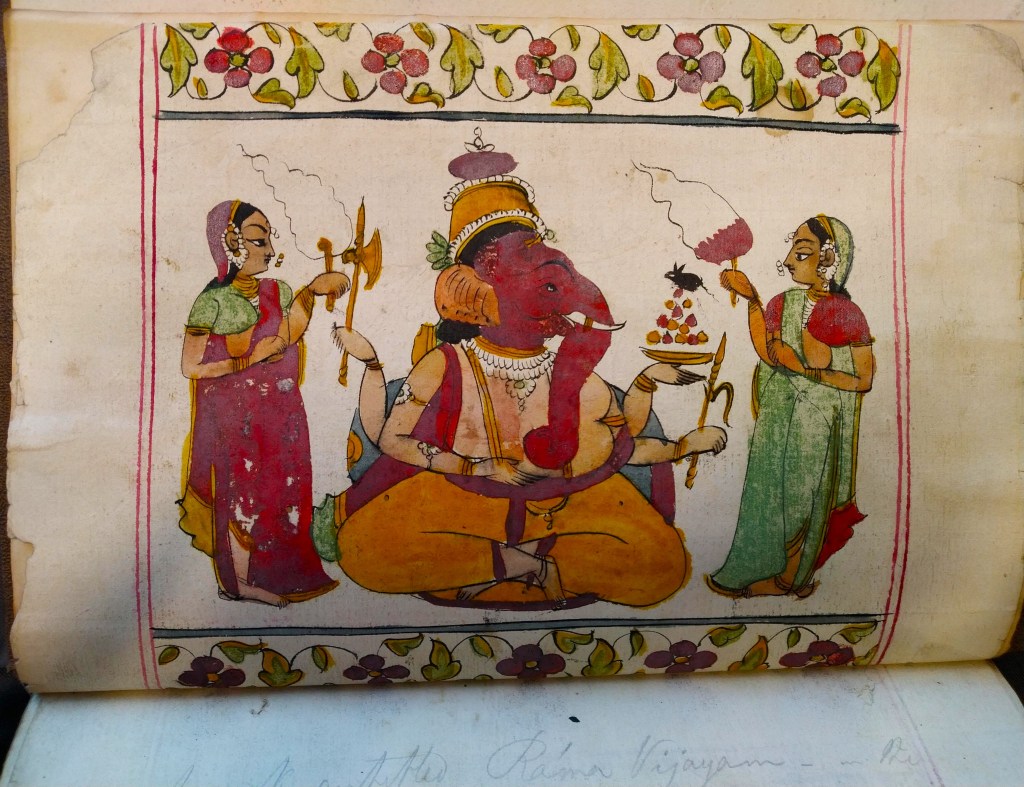
In India every NEW beginning is associated with the worship of Lord Ganesha (the elephant head god). It is said that the epic of Mahabharata was written down by Ganesha on the composition of sage Vyasa.
Here is the painting of the four-armed Ganesha holding His weapons in two rear hands and a plate of sweets with a mouse on top of it (much animated, as if in conversation with the God) in one hand, while the fourth-hand rests on His big stomach, flanked by two consorts Riddhi and Siddhi holding flying whisks. Showing the face in complete profile is very common in miniature painting, a much easy application of face for artists for mass production of MSS.
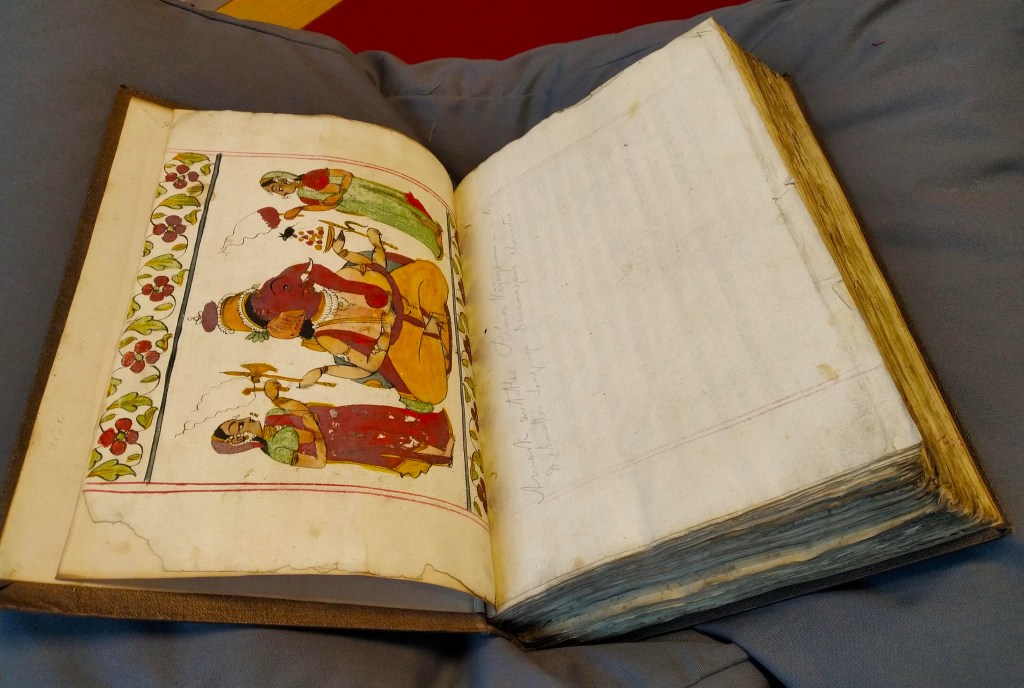
Composed in a dramatic floral design are the images of Lord Ganesh with his consorts Riddhi and Siddhi (meaning Wisdom and Power to attainment respectively). The figures show the Deccan Maratha influence on their clothing (a long nine-yard sari) and jewellery (a peculiar pearl nose pin resting on upper lip). Both shown with whisk in their hands blowing gentle wind to Ganesha. With limited colours used here, we see artist making no compromise with quality of the work and continue to render as many details as possible with a very thin brush, seldom with single hairbrush.
The reason to this limitation of colours is in its organic structure. The colours were made at home with natural pigments. Yellow or Indian yellow as we see here, obtained from minerals or plants, green often mixer of yellow and blue and red from the soil or with treatment on turmeric. Such three colours were most popularly used and were also considered to be holy when the turmeric was used.
Characteristic Features of the MSS Adi Parva
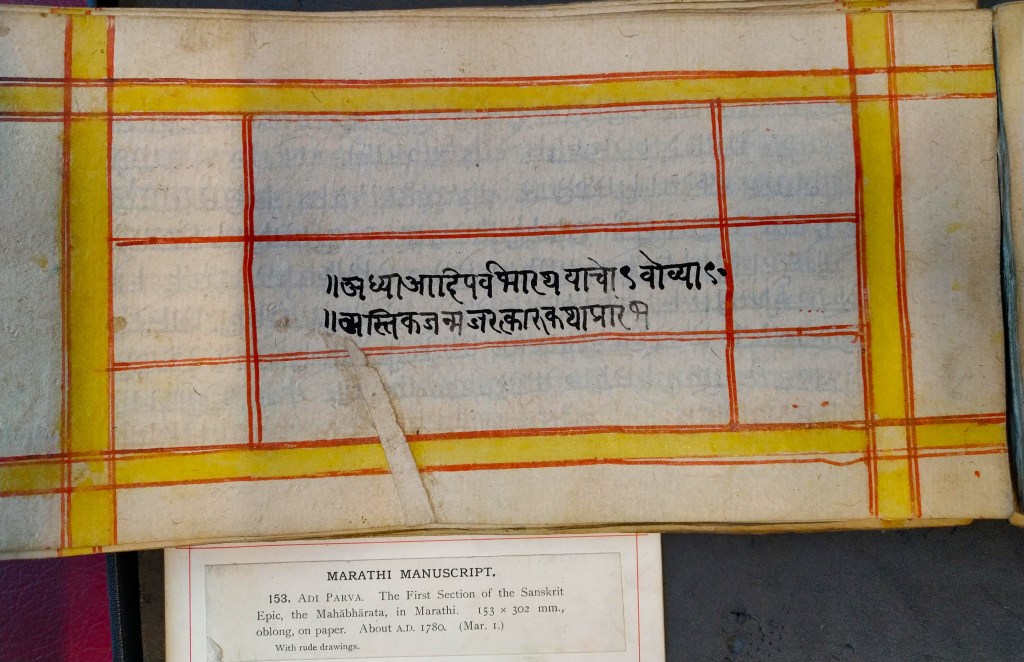
These MSS are in the form of loose folios. Each page is written on obverse and reverse side with black ink, on both the sides are the bright yellow thick borders and thin red lines, both the colours are organically prepared.
The other set of loose folios in the collection of JRL is dated to c. 1780 (fig.3, 4). Entirely handwritten with a bit of crude or rough writing and with a very few illustrations, it triggers a few curious points and comes up with answers of few out of them. To begin, this one set is written in Marathi, and is from Maharashtra. Though the original Adi Parva is in Sanskrit as said earlier, this one is from those many versions written over a huge timeline. Marathi being my mother tongue, there was feeling of close connectivity with the text, the dialect of the 18th century (of which obviously many are gone under the sands of time).
The Drawings and the Yellow borders
The style of writing and art belongs to the 18th century Maratha Dynasty period. This was particularly the time when the recital of the verses from Ramayana and Mahabharata was very popular. The verses then were written in many Brahmin families as part of custom. Not every family belonged to the artist community, hence the text often dominated the MSS. However, in few cases we see the writer taking initiative to render some line drawings, which could seldom look like a professional artwork and often resulted in crude sketches, only to be able to interpret by the family and not public. The line drawings showing four-armed deity (Vishnu?), face in profile.
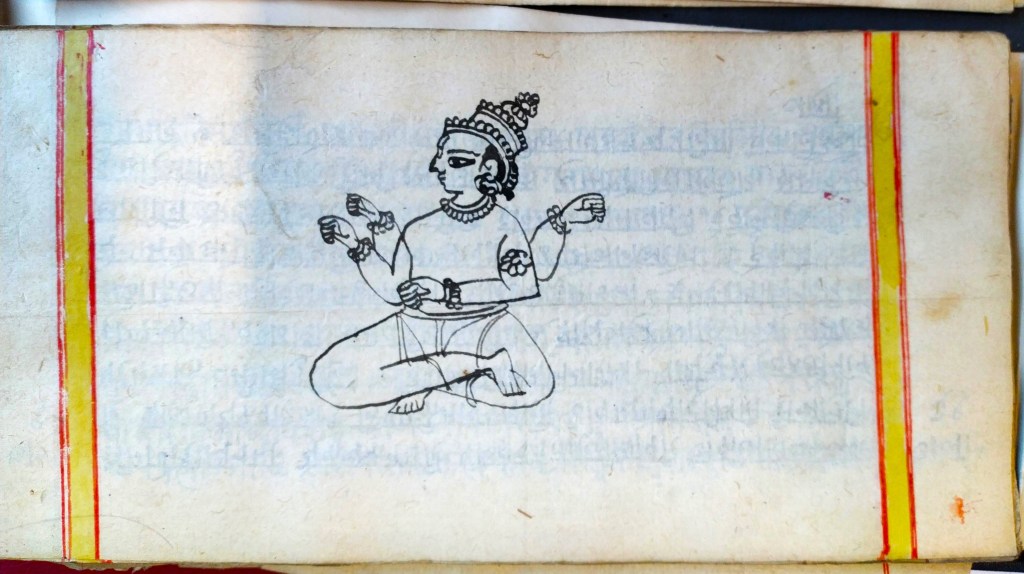
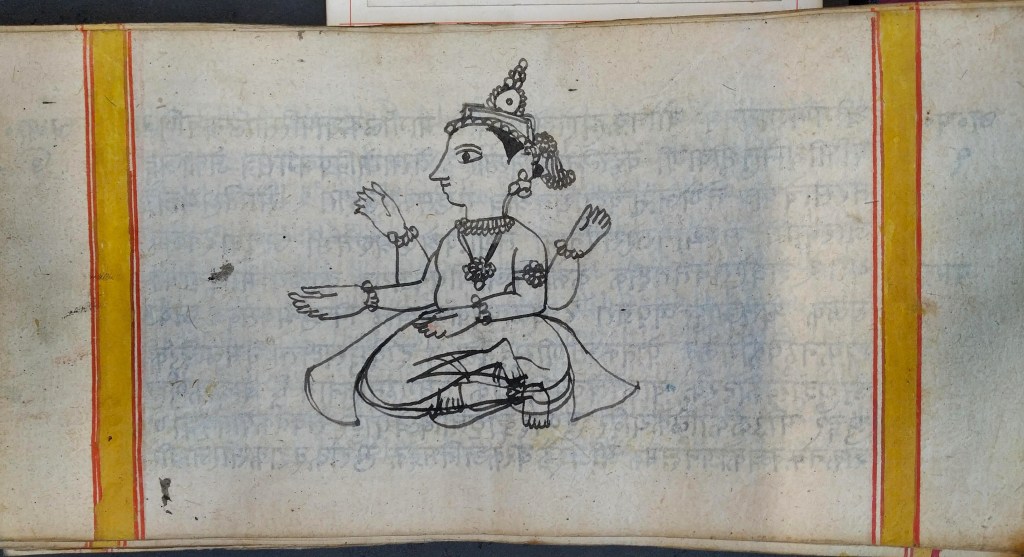
The above figures (5,6) have no sophisticated rendering at all. They are probably meant to be there as a part of symbolic appearance, to indiacate the auspicious text. Looking more like a sketch, they belong to the Deccan art style, which emphasises on thick lines and pump bodies if not robust.
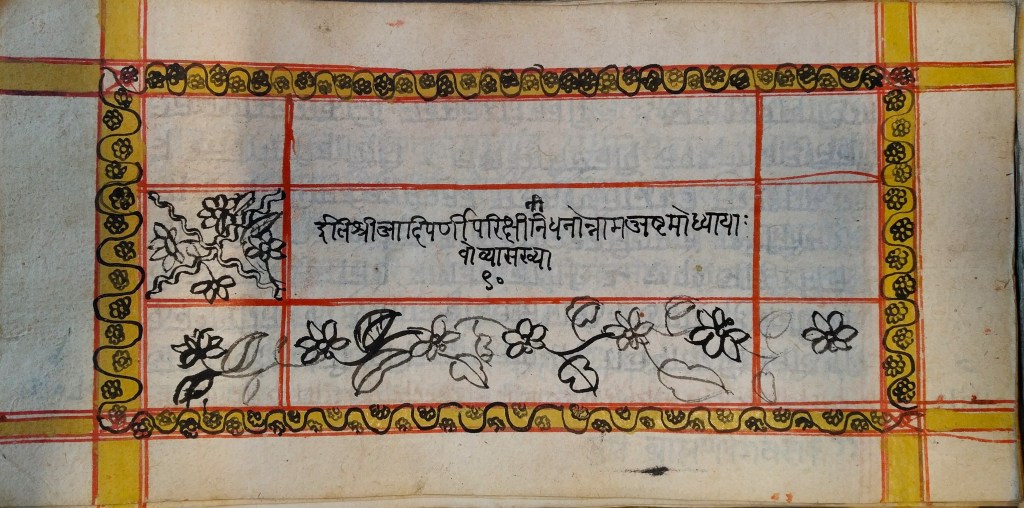
The significance of the borders need to be understood in the ancient Indian text. The two specific colours yellow and red are much symbolic in Indian rituals. Totally organic, these colours are considered as holy colours, those of turmeric and kumkum, the composition of specific soil (tapioca) and turmeric, considered as very auspicious powder and hence used in every ritual by both men and women. The outlines create a frame or a margine for the writer to begin. The MSS misses the horizontal lines, leaving the reader surprised, for most often the words do not get jumbled. The handwriting of this MSS particularly, even though several pages, looks much neat and tidy and almost all the papers are outlined.
The drawings on many folios are extremely crude yet interesting as they belong to the typical folk nature of art practices, mostly subtle geometric patterns and floral forms, not following symmetry or repetition.
The entire collection of Hindustani MSS at the JRL is prodigious collection depiction knowledge and aesthetics of the ancient culture. I sincerely thank the entire team of JRL for having given this precious experience to me. The library has indeed made all the possible efforts to protect and store these MSS in wonderful infrastructure under the supervision of experts. I thank Dr Zsofia Buda for her valuable time for discussions and of course the young girl Nicole for carefully giving me all the needed assistance.
 ink talking